
Tools of the Trade
This blog post was originally written and sent to my email list. If you like what you’re learning, contact me and I’ll put you on my email list so you get updates and useful information fast! Don’t worry – all my emails are original and are not spammy. Happy to help you on your fitness journey!

Last week I wrote a post about the underlying mechanisms for muscle building – the physiological “how” we gain and build muscle. As a quick refresher, there are three: mechanical tension, metabolite accumulation, and muscle damage.
The workouts I design in the gym will attempt to check all of these boxes each time you’re here.
That’s the “how” we get stronger. Today I wanted to peel back the curtain on the “why,” at least when it comes to exercise selection. Why a barbell vs. a dumbbell? Why a kettlebell vs. a TRX? Why a split lunge vs. a squat?
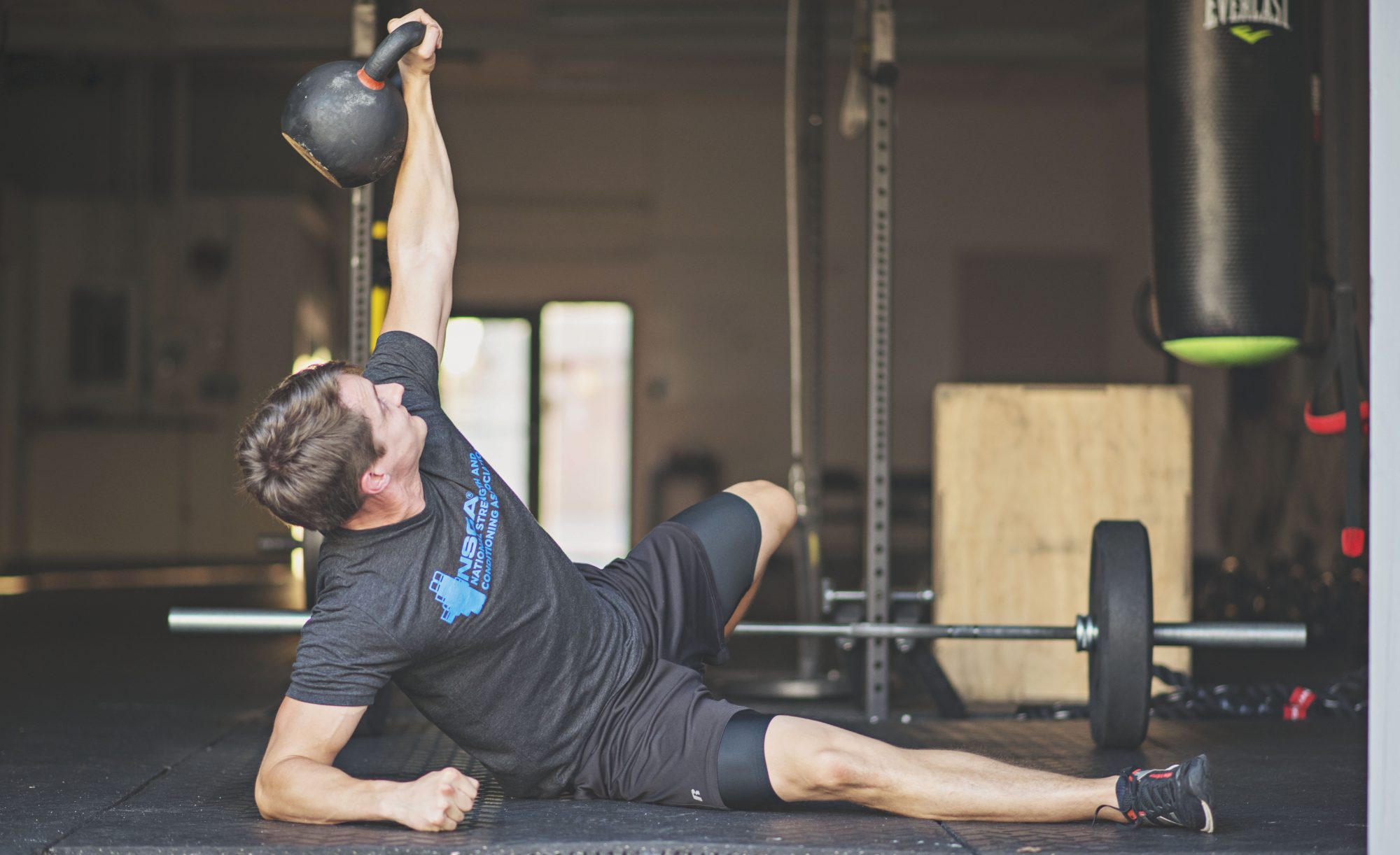
There are several reasons we can choose one tool over another, but that’s just it – they are only tools. We have lots to choose from to get the job done. In no particular order, here are some considerations when I design your workouts:
1) How comfortable is the exercise? Does it feel good with this tool over that tool? Is the learning curve shorter on one vs. the other? If an exercise hurts (in the bad way) or is difficult to learn, it’s hard to get a great workout in. I’ll often choose the exercise that looks and feels the best for you and rock it.
For some of my clients, this means a trap bar deadlift (the big hexagonal shaped bar) vs. a traditional barbell. Sometimes it means a goblet squat vs. a barbell squat. The simpler the better and the easier it is to improve fitness.
2) Is the exercise scale-able? Like we discussed last week, in order to continue getting stronger we must find ways of pushing our limits. This can be achieved by adding weight (load), adding reps, adding sets, or some combination. Sometimes the limitation is the tool itself, and once you outgrow a tool’s ability to challenge you, we migrate to the next tool for the job.
This might look like a kettlebell deadlift at first, then a traditional barbell deadlift later. The barbell has what we call “sleeves” that we load the plate onto. Those sleeves merely represent potential for loading more weight and increasing your strength over time. The limitation with a goblet squat is how tolerable you are to holding a heavy weight in your hands. The big safety bar (the bar with pads all over it) is the same exercise, but a more comfortable application.
3) Constrained vs. Un-constrained exercises. If you’re sitting down, stand up. Once you’ve got your balance, try and lift one knee up to waist height and hold it there. You might find your balance and ability to stay there is more challenging. This is the essence of constrained vs. unconstrained exercises.
Constrained: When we squat or deadlift with both feet firmly on the ground, we’re balanced, coordinated, and stable. Because of this orientation, you’ll always be stronger with a bilateral (both feet) exercise over a unilateral (one foot) exercise. Likewise, when we do pushups (both hands on the ground) or barbell bench press (big bar in both hands), we’re more stable right to left, allowing us to leverage more weight and increase strength.
The downside to this orientation is that there might be a weakness between our right and left limb, and we wouldn’t know the difference. Additionally, our lives outside the gym are rarely as simple as some of the exercises we do in the gym in terms of balance and coordination.
Unconstrained: anything we do on one leg, like a lunge or split squat; or any exercise where our arms are moving independently, represent a more unconstrained orientation. The benefit of this setup is that we can try and equalize strength disparities between limbs, and like I mentioned before, our lives are often spent with one or two limbs moving independently at the same time. The downside is that because we have to expend a little more energy balancing ourselves, or stabilizing a weight in free space, we can’t leverage as much total load as we might with both arms or both legs. Less weight moved mean less potential for total strength improvements.
If you’re moving furniture around your home, you’re most likely picking things up with both legs and both arms moving simultaneously. This is because we’re stronger this way than if we tried to move heavy objects with only one arm or one leg.
Which one is better? Neither. We use both orientations often in the gym for this very reason: constrained and unconstrained have their pros and cons, so we do both.
To recap:
To get stronger we’ll pick up heavy weights or do more reps. We’ll work with independent arms and lunge with a single leg, and we’ll often push and pull barbells with tons of weight and both limbs to increase strength as quickly and efficiently as possible.
We’ll use all the tools available to us to get a solid workout in. We’ll learn new tools and tricks along the way. Eventually it’s my goal to make you as strong and confident with all of the tools as I am. One day you may leave to work with another coach or find yourself in a commercial gym space. I want to make sure you’re strong, capable, and confident with everything at your disposal so that you’ll be a competent lifter for life!
That’s all for today. Thank you so much for being here and if you have any questions, please holler at me!